September 9, 2026
Beyond GEO: How Communications Shapes What AI Knows About Your Brand

A diagnostic framework you can start using today to close the gaps between what your brand actually does and what AI says about it.
Stop treating GEO as another channel
You've been told you need a GEO strategy. Someone in a board meeting or a client call raised it, and now it's sitting on your desk as a mandate with no clear next step. The obvious response is to treat it like any other emerging channel: stand up GEO content, build a GEO reporting deck, maybe bring in a GEO agency, or bolt on a new dashboard.
Don't.
The industry has cycled through GEO, AEO, LLMO, and other labels for the emerging discipline of influencing how brands appear in AI-generated answers. We use GEO here, but the acronym matters less than the underlying shift: communications teams now need to understand not just whether a brand appears, but how it's represented, what appears to be shaping that representation, and what they can do about it.
AI answers about your brand draw from an information environment communications already influences: your owned content, the coverage you earn, the customers and analysts who talk about you, the categories you're associated with, and other third-party sources across the web. If that system is what's shaping how AI represents you, the fix isn't a new workstream sitting next to the program you already run. It's a different way of making decisions inside that program.
We’re not here to give you another list of AI SEO tactics. The following is a framework for diagnosing what's actually shaping your AI representation and for choosing marketing and communication actions that address the root cause rather than the nearest symptom.
Step One: Start with representation, not visibility
Most GEO advice starts with the same question: where do we show up? Which prompts surface our brand, how often, in what position. It's a reasonable question, sure, but it's the wrong one to start with.
The better starting question is, what does AI actually understand about us? Showing up isn't the same as being understood correctly, and being understood correctly isn't the same as being understood the way you want. Before diagnosing anything, it's worth checking:
- Are we associated with the categories we actually want to own, or with the ones we happened to get lumped into?
- Do our real differentiators survive in the answer, or do they flatten into the same generic description every competitor gets?
- Are the answers factually accurate, or is AI repeating something that used to be true?
- Who gets recommended instead of us, and in what context?
- How consistently do these patterns hold up?
That last point is worth thinking through. A single AI answer isn't “truth,” and a visibility score isn't a strategy. What matters is whether a pattern holds up under repeated, varied testing. Treat any one output as a data point, not a verdict, and you'll avoid the trap that's caught a lot of teams already: reacting to a single strange answer instead of understanding the pattern behind it.
Step Two: Find out what's shaping that representation
We've written before about Influence Architecture: the idea that brand perception is produced by an interconnected system of signals, not any single channel. GEO gives communications teams a new, concrete way to observe that system in action.
In practice, that means inventorying three things: 1) what you're saying (owned channels, research, executive commentary, product materials), 2) what others are saying about you (media coverage, customer reviews, analyst notes, creators you’re not already collaborating with, community discussion, directories), and 3) what AI is actually repeating back when someone asks about your category. Line those three up, and the differences tell you where to look.
Those differences tend to fall into one of five gaps:

Two of these are worth extra attention. The first is the association gap: it's the one that says more visibility isn't always the answer; sometimes, the job is changing what your visibility actually means. Being present in an AI answer doesn't help if it's attaching you to the wrong category or the wrong use case.
Don't only test for absence. Test for unfavorable representation, too. Most teams naturally build prompts around where the brand should appear or that they want to “win.” It's equally important to look for where the brand does appear, but with a negative, outdated, or otherwise damaging frame. That pattern may ultimately trace back to a narrative, authority, source, freshness, or association gap, but you won't diagnose it if your prompt set never gives it a chance to surface.
One more distinction worth holding onto: source, not presence. Presence risks sounding like visibility again, which is exactly the framing we’re arguing against. A source gap is about where the evidence for your story actually lives. Fixing it means strengthening the right information environment, not chasing more mentions.
Step 3: Choose the communications intervention that matches the gap
Once you know which gap you're dealing with, the intervention should follow logically, not from a generic tactics list, but from the specific problem you just diagnosed:

A narrative gap doesn't get fixed by publishing more content; it gets fixed by making sure the same story is actually being told across your owned channels, executives, media coverage, and social presence. More content won't solve a fragmented narrative; it may just create more versions of the story competing with one another.
An authority gap rarely gets fixed by rewriting your own website copy alone. Your owned content can establish the claim, but independent sources help substantiate it. The strongest version of that is often more ambitious than a press release. A co-branded research report with an analyst, an independent expert, or a relevant research organization can provide evidence that someone other than your brand is willing to put their name behind it.
A source gap doesn't get fixed by chasing more coverage volume; it gets fixed by figuring out which sources are actually shaping the information environment around that question or category and building presence there specifically, even when they're lower-volume than your usual media targets. The best source for a priority question may not be the outlet with the biggest audience; it may be the niche publication, industry organization, comparison page, community, or expert that consistently appears around that topic.
A freshness gap means asking what the old story is competing with. Updating your website may be necessary, but if outdated descriptions still dominate third-party sources, the intervention has to extend beyond owned content.
An association gap doesn't get fixed by adding a keyword; it gets fixed by building real, sustained evidence that you belong in the category you're trying to own. Say an enterprise software company is consistently described and recommended as a video conferencing tool, but the business has spent the last two years repositioning around AI-powered customer communications. The problem isn't that AI can't find the company; it's that the information environment still associates it more strongly with the category it came from than the one it's trying to lead. Closing that gap means building sufficient credible evidence for the newer association (through the company's experts, customer stories, research, earned coverage, owned content, influencer campaigns, and other relevant sources) so that the market story starts to catch up with the business strategy.
It's also worth widening who counts as a potential partner here. The most useful sources for authority and source-gap work are often not the obvious media targets. Competitors on adjacent, non-competing topics, large organizations or industry groups in your category, and associations that most PR teams wouldn't think to approach for a communications or content partnership can create exactly the kind of independent, credible evidence that strengthens the broader information environment around your brand. That's a different kind of outreach than a standard media list, and it's worth building deliberately rather than waiting for it to come up.
If a competitor keeps winning, don't copy the tactic. Diagnose the advantage. Are they clearer? Better substantiated? Present in more influential sources? More current? Better associated with the category? The intervention depends on the reason, not the fact that they're winning.
Fill influence gaps, not just content gaps: that's the whole discipline. Every intervention on this list is a response to a specific diagnosis. None of them are things to do by default.
Step 4: Run GEO like an experiment, not a scorecard
Stop chasing proof that one action caused one AI answer. What you're building instead is a pattern of evidence solid enough to make better marketing and communications decisions.
That means running GEO as a loop rather than treating each visibility score, prompt result, or campaign as a standalone verdict.

→ Observe means establishing the repeated pattern. Test a stable set of prompts at a consistent cadence and look for what holds up across questions, platforms, and time. If your prompt set changes every time you look, you can't tell a meaningful pattern from noise.
→ Diagnose means forming a specific hypothesis about the gap that could be producing that pattern. Not "we should do more GEO," but "we think this is an authority gap because our differentiators appear in our owned content but aren't consistently reflected in independent sources or AI answers." The goal isn't certainty; it's a reasoned explanation you can actually test.
→ Intervene means choosing the communications action because it matches that diagnosis, not because it's the tactic you'd usually reach for. An authority hypothesis might lead to targeted earned media or third-party research. An association hypothesis might require sustained expert positioning around a category you aren't yet strongly connected to.
→ Test means returning to the same questions and looking for movement. Run the same prompt set across the same platforms after enough time has passed for the information environment to change. This is where language discipline matters most: you're not trying to prove that a specific piece of coverage trained a model or caused a specific answer. You can't observe that. What you can observe is whether representation changed, whether the sources surrounding that representation shifted, and whether the pattern holds up across repeated tests.
→ Learn means documenting what happened and carrying that evidence into the next cycle. Did the pattern move in the direction you expected? Did nothing happen? Did something change that challenges your original diagnosis? Keep the record. Over time, those cycles give you a stronger basis for deciding which parts of your communications program deserve more investment and which assumptions need to be reconsidered.
Here's what that looks like end-to-end: say a competitor consistently outperforms you in AI answers for a use case you consider core to your category. You observe that the pattern holds across repeated tests. You diagnose a potential authority gap because the competitor has stronger independent substantiation around that use case. You intervene with expert commentary and targeted earned coverage designed to strengthen that evidence environment.
You test the same prompts again a few weeks later, looking for changes in representation and sources. Then you learn from what moved (or didn't) and use that evidence to determine the next intervention.
That's the whole loop. It won't tell you that one article changed one answer. It will tell you, over several cycles, which parts of your communications program appear to be influencing the representation you care about, and give you a better basis for deciding what to do next.
Step 5: A practical 30-day starting point
Week 1: Define the representation you care about. Name your priority narratives, the audiences and use cases that matter most, and the competitors you're tracking. Draft around 20 representative questions a real buyer or stakeholder might actually ask an AI tool about your category.
This is also the moment to loop in whoever owns SEO, if that isn't already you. Communications and search teams operate in different parts of the same information environment, but in many organizations, they rarely compare what they see. Share the questions you're testing, the narratives you're trying to own, and what each team knows about the sources and search signals surrounding them. The priority is to avoid diagnosing the same problem from two disconnected views.
Week 2: Establish what AI is actually saying. Run your question set across the platforms your audience actually uses. Test your own brand and your named competitors. Separate the answers that repeat consistently from the ones that look like one-off noise; only the repeated patterns are worth acting on.
Week 3: Diagnose one influence gap. Resist the urge to fix everything at once. Look at what you found in week two and name the single clearest problem: narrative, authority, source, freshness, or association. One clear diagnosis beats five vague ones.
Week 4: Design one intervention. Choose the communications action that logically matches the gap you named, write the hypothesis down, and set an actual date to retest.
Don't try to optimize for AI everywhere at once. You won’t be able to, and fixing an entire environment is a massive undertaking. The point of this first month is to learn which parts of your influence system actually matter for the narratives you care about. By the end of it, you won't have solved GEO. You'll have a working diagnosis, one intervention in motion, and a process you can repeat every quarter instead of starting over the next time someone asks what your GEO strategy is.
Start with the gap
The platforms will change, the terminology will change, and the tactics will change. The more durable skill is knowing how to diagnose what you're seeing before deciding what to do about it.
Start with the representation you care about. Look for the pattern. Diagnose the gap. Choose an intervention that matches it. Test what changes, learn from it, and repeat.
You don't need perfect attribution to make a better decision. You need enough evidence to make the next one smarter.
Want to understand how your brand is showing up in AI, and what may be shaping it? Drop us a line at info@justdrivemedia.com.
Related Stories

Communications Has an Intelligence Advantage. It’s Time to Use It.
Impressions and share of voice describe what happened, not why. A better approach to measuring communications effectiveness, and what it asks of comms teams.
September 15, 2026

The Real AI Opportunity for Communications Teams
How communications teams can use AI to connect internal knowledge, market signals and business impact.
August 20, 2026

LinkedIn in 2026: What Matters Now
Explore the latest LinkedIn best practices for profile optimization, content strategy, engagement, and executive visibility to strengthen your professional presence.
June 17, 2026

How YouTube Is Reshaping B2B Buyer Research
Based on an analysis of 135 videos, learn how buyers discover, evaluate, and choose solutions—and what it means for your B2B marketing strategy.
April 27, 2026

Influence Architecture: How Modern Brands Are Actually Built
Modern brands build trust with Influence Architecture: aligning performance, narrative, visibility, and credibility into a system that compounds over time.
April 14, 2026

Built With, Not For: The Case for Developer Education as Advocacy
Developer education drives advocacy when it lowers the barrier to entry, builds confidence, and helps people see where and how they can participate.
February 5, 2026

Social Media for Executives: The Influence Economy Has Come for the C-Suite
Discover how top Inc. 5000 executives are driving influence and building credibility through authentic, human social media content.
October 20, 2025

From Upvotes to Influence: How Reddit Marketing is Redefining Brand Trust Online
Learn how Reddit marketing is reshaping brand trust, search visibility, and AI results in 2025, and how your brand can win on the platform.
October 9, 2025

The Rise of GEO: What Brands Must Do to Stay Visible in an AI-First Search Era
Search is changing fast. Discover how to shift from SEO to GEO and keep your brand visible in AI-driven, zero-click search results.
August 19, 2025

The Rise of the Employee-Influencer: Why Your Best Advocates Might Already Be on Payroll
Explore the growing power of employee advocacy and how companies can harness the authentic voices of their teams to build trust, expand reach, and strengthen their brand.
July 28, 2025

The AI Power Players: Who’s Influencing the Narrative? And What Can Business Leaders Learn from These Voices?
Who’s shaping the conversation around AI, and how? We analyzed the data to spotlight the most influential voices driving public opinion, platform adoption, and policy.
March 27, 2025

AI, Adaptability, and Autonomy: The Future of Marketing Belongs to Those Who Invest
Marketing is changing with incredible speed. Learn how transparency, tools, and trust can help you and your team harness the chaos.
December 20, 2024

LinkedIn Creators Are Changing the Game for B2B Marketing - Are You Ready?
Discover how LinkedIn creators can help humanize your B2B marketing, build trust, and drive stronger connections—an untapped opportunity many brands are missing.
November 18, 2024

Why Executive Communication Is More Critical Than Ever, and How to Do It Right
Learn why executive communications are key to building trust, engagement, and visibility, and how that impacts business results.
November 13, 2024
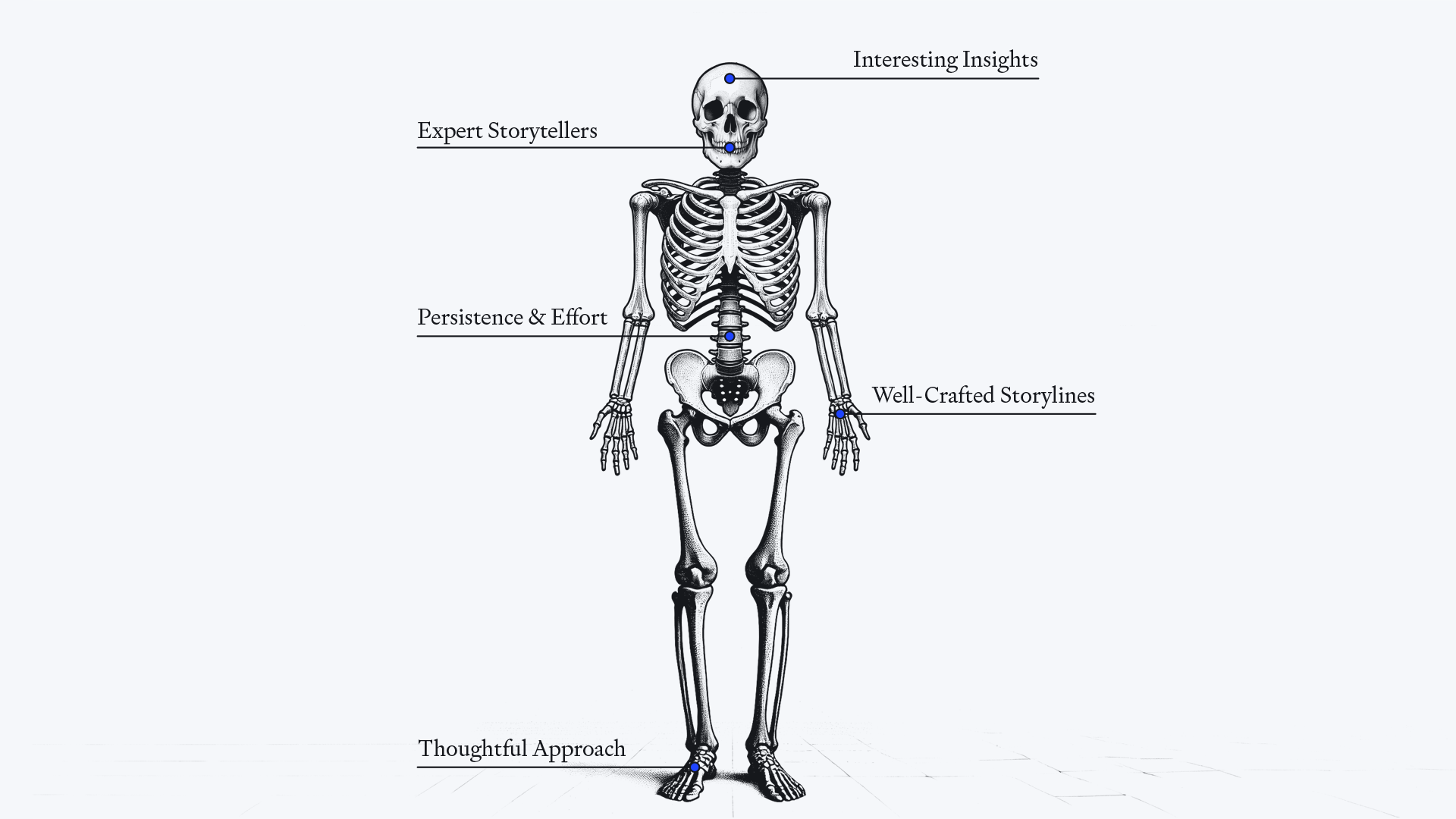
Anatomy of Coverage: How to Break Through to Media
These 5 elements consistently drive media coverage.
August 8, 2024

The Art of Listening: From Diverse Signals to Business Value
Measuring content strategies to determine what's driving the most value can be tricky. Here's what to think about when it comes to media measurement, social listening, and brand signal analysis.
May 21, 2024

Uncovering The “Who” Behind Your Social Audience
Discover how understanding your audience's diverse segments can unlock new strategies for engagement and growth—dive into the art and science of audience analysis.
June 5, 2023

How To Plan Ahead For a PR Crisis
Ever wonder how top brands navigate a PR crisis? Check out this guide to learn how to craft a solid strategy that will protect your brand's reputation.
October 6, 2022

5 Questions Before Hiring A PR Agency
Before you leap into the world of PR, make sure you're ready for primetime. Peek inside to learn how to set your team up for success and get the most out of a PR partnership.
August 18, 2022

Stop Fighting Social Algorithms And Do This Instead
Struggling to keep up with social media algorithms? Find out how a simple shift in your content strategy can dramatically boost your brand's presence.
August 3, 2022
The Unique Challenges And Opportunities Of B2B Influencer Marketing
Influencer marketing isn't just the realm of consumer marketers. See why it's a hidden gem for boosting trust and referrals for B2B, too.
July 6, 2022
Is Podcasting Your Next Big Move? Why It's Time to Tune In.
Is your brand ready to amplify its voice? Dive into the podcasting wave and learn why it might be the strategic play your business shouldn't miss.
June 15, 2022

5 Steps To Running A Smooth AMA On Social Media
Ready to host an AMA that sparks conversations and connects deeply with your audience? Dive into our five essential steps for a seamless social media event.
May 12, 2022

Inside Our Metric Ecosystem - And Why It Wins Awards
Explore the foundation of our award-winning methodology and learn how we tap the power of social data for better decision-making.
May 1, 2018

The Myth Of Insta-Media Coverage & The Truth About "Big" Placements
Aspiring to achieve launch-day headlines? Pull back the curtain on the real strategies and tactics behind major media attention.
November 9, 2017